What happens when a gym discovers that its members are also an audience?
A gym usually knows what business it is in. People arrive. They train. They sweat. They leave. Some come back tomorrow. SweatBox, a combat-sports gym in Addis Ababa, found a slightly different use for the people walking through its doors. Some of them could fight. Some could talk. Some had rivalries. And, importantly, some were interesting enough that other people wanted to watch. That became the Ethiopian Fighting Championship, or ETFC.
On the surface, it is a fight promotion. But look a little closer and something more interesting is happening. SweatBox has turned a community built around a physical service into an entertainment property that can exist far beyond the gym. It may have been the original business.
It wasn't necessarily the only one hiding there.
First, you need people worth watching
Entertainment has always had a useful trick: take something people already care about and give them a reason to care more. Sport is particularly good at this. The rules are simple. Someone wins. Someone loses. There is a clock. There are consequences. But none of that explains why people become attached to particular athletes.
For that, you need characters.
SweatBox already had them. Its athletes had personalities, coaches had opinions, competitors had histories and fights created natural rivalries. ETFC simply gave those ingredients a stage. Training became part of the story. Face-offs became events. Press conferences created anticipation. A fighter was no longer just someone preparing for a bout. They became someone audiences could have an opinion about. And once people have an opinion, they tend to want to see what happens next.
That is where a fight becomes something more than a fight.
The bell rings. The internet keeps going.
A fight lasts minutes. The conversation around it can last much longer. That distinction shows up clearly in what happened on TikTok.
An analysis of three ETFC-related hashtags found 453 unique videos with more than 14.6m cumulative views. But the interesting number is where those views came from: 87.36% were generated by accounts outside ETFC's own channels. In other words, ETFC created something other people wanted to talk about. Fans posted footage. Creators made commentary. Meme pages turned fighters and moments into jokes. Audio was remixed. People argued over what happened. The audience became part of the media operation without necessarily thinking of itself that way.
There were 347 community and user-generated videos in the analysis, generating 5.79m views.
This is one of the peculiar economics of entertainment. A company can spend money producing content for an audience. Or it can create something the audience finds worth producing content about. The second option is considerably more interesting.
Then one fighter lost, and the internet got busy
Perhaps the best example was Sedo. His post-fight reaction became the single biggest asset in the analysis, generating roughly 2.7m views, 576,000 likes and 34,800 shares. The fight itself was over. The content wasn't.
In fact, reactions performed particularly well across the dataset. Fighter reactions had the highest median views among the major formats analysed. This tells us something about what audiences were actually interested in. Not just who won. How did they feel about winning? How did the other fighter react? What did they say? What happened afterwards?
Sport supplies the result. Personality supplies the drama. And drama is much easier to share than a result.
Although more than 450 unique videos were captured, there is another useful wrinkle in the numbers. The attention was highly concentrated among the top 20 videos which accounted for 72.8% of the total views measured.
So the lesson is not that ETFC produced an enormous quantity of viral content. It didn't.
A relatively small number of moments did most of the heavy lifting.
That is how entertainment often works. One knockout, one reaction, one ridiculous exchange or one unexpected result can give hundreds of other people something to talk about. The event creates the moments. The audience decides which ones matter.
[ETFC IN NUMBERS]
The distribution of attention also offers a useful lesson for brands.
The 453 videos did not perform evenly. The top 20 accounted for 72.8% of the total views measured.
This suggests that entertainment is less a game of producing endless content than of creating moments with enough force to travel.
Post-fight reaction from Sedo generated about 2.7m views, 576,000 likes and 34,800 shares, making it the standout individual asset in the analysis.
And then Ethiopia got hold of it
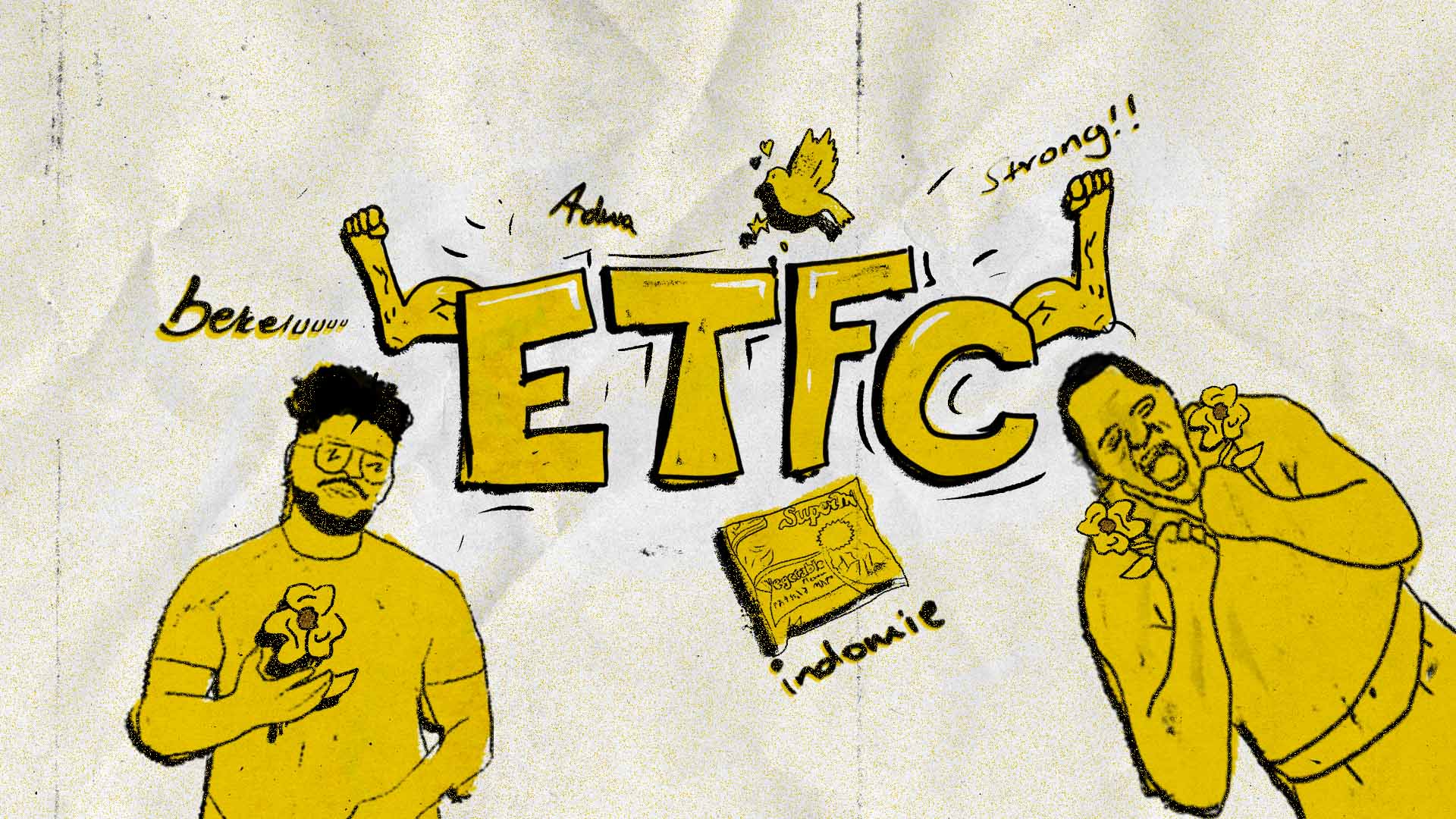
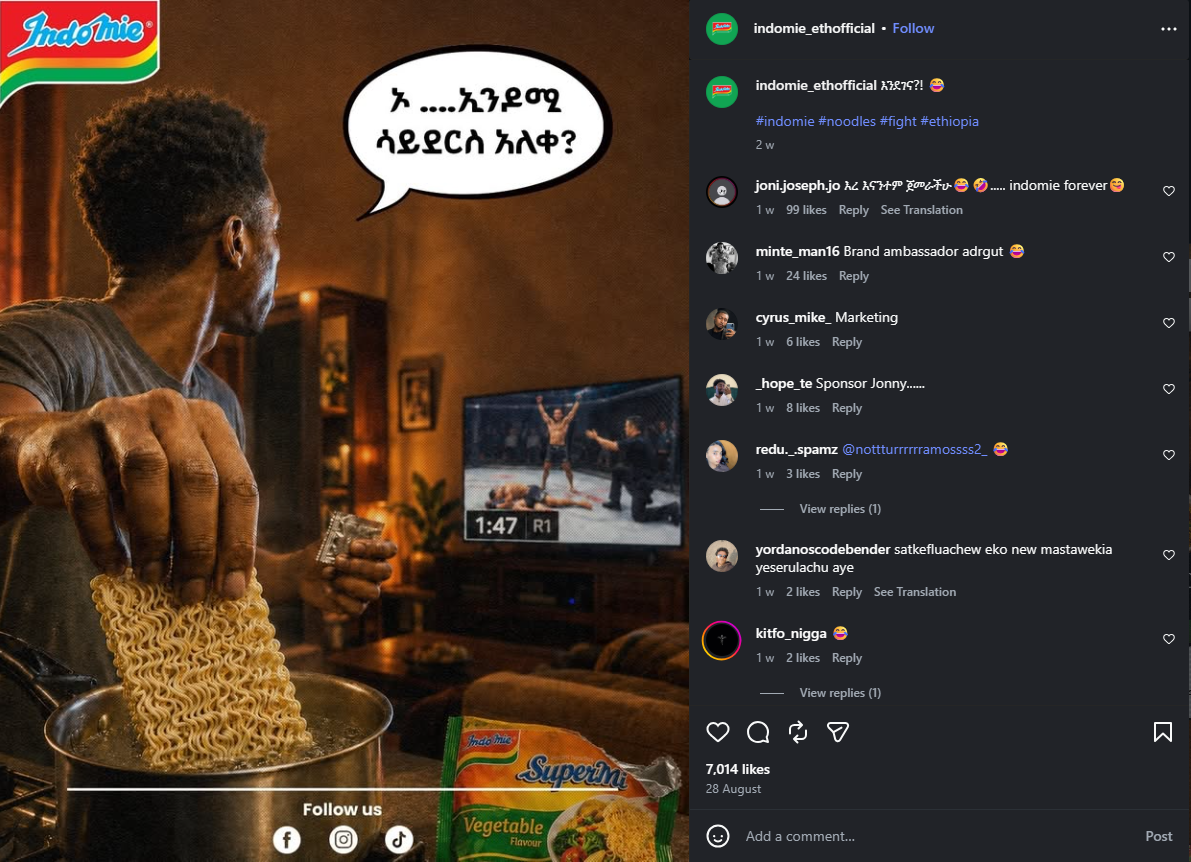
There is another layer to what happened after the fight. The audience didn't simply talk about ETFC. It started turning the fighters into characters of its own. Sedo became a particularly good example. After the fight ended earlier than many expected, social media began associating him with Indomie. The joke was simple: the fight hadn't lasted long enough for the noodles to finish cooking. The meme quickly became bigger than the original moment. People were no longer just discussing how Sedo fought. They were making jokes about Sedo the character, using a familiar Ethiopian internet reference to explain what had happened.
Then Indomie Ethiopia joined the conversation. Its response played directly into the joke, showing the fight ending before the noodles were ready. A brand had effectively entered a conversation that its audience had started for it.
That is one of the more interesting things about entertainment on the internet. Once an audience becomes invested enough, it starts producing its own version of the story. Fighters become memes, moments become inside jokes and brands can sometimes step into those conversations rather than having to manufacture them.
The same thing happened with Pagumē. In Our analysis, culturally localised content around themes such as Pagumē, instant noodles and Adwa generated a higher measured share rate than generic commentary. People were turning it into material for Ethiopian internet culture. And that is a much stronger position for an entertainment property to occupy than simply having people watch its posts.
The audience, on top of watching a fight, was finding ways to make the fight belong to them.
— Indomie Ethiopia jumping on the internet culture created by the ETFC outcomes
The gym was never really the whole business
This is where the story gets bigger than ETFC. A gym is constrained by physical space. There are only so many members, classes and hours in a day. An entertainment property has fewer physical limits.
Its fighters can appear on screens. Its stories can circulate between events. Its audience can create its own content. Sponsors can attach themselves to the attention. Broadcasters can distribute the event. People who will never become SweatBox members can still become ETFC fans.
The physical business creates a community.
From that community characters arise. The characters create stories, the stories create events, and the events give the audience something to talk about, bringing more people into the community.
That is the entertainment property flywheel in a nutshell.
The clever part is that SweatBox didn't begin by asking, "What new business should we start?" It had already built something valuable. It just found another way to use it. That may be a useful question for other businesses too.
Not: What else can we sell?
But: What else are the people we've already brought together interested in?
Sometimes the second business is sitting inside the first one, waiting for someone to notice.
[READER APPLAUSE & ENGAGEMENT]
DID THIS ESSAY PROVOKE A THOUGHT?
Support this essay. Readers can contribute up to 50 claps to the studio tally.
Before Illustrator, Canva, Pinterest and AI, there was one kid who could draw, carbon paper, and a neighbourhood ready to copy.
Somehow, those humble New Year drawings became a visual language nobody ever formally designed.
We thought the little flower on our coffee cup was Ethiopian. Then we found the same one in Lebanon.
Turns out, it may have travelled through centuries of porcelain, trade and cultural exchange before becoming something we simply called sini.
Let's make something magical.
Whether you have a reaction to our publication volumes, an inquiry for branding & design experiments, or a collaboration in mind, our studio doors are open.