The Business of Making People Care
A gym has a ceiling. A community doesn't. SweatBox found a second business inside its gym: ETFC, an entertainment property built around fighters, stories and an audience that helped spread it.
Google “Lebanese coffee cups.” Yup. We were just as surprised.
There are some things you don't question because they feel too ordinary to question.
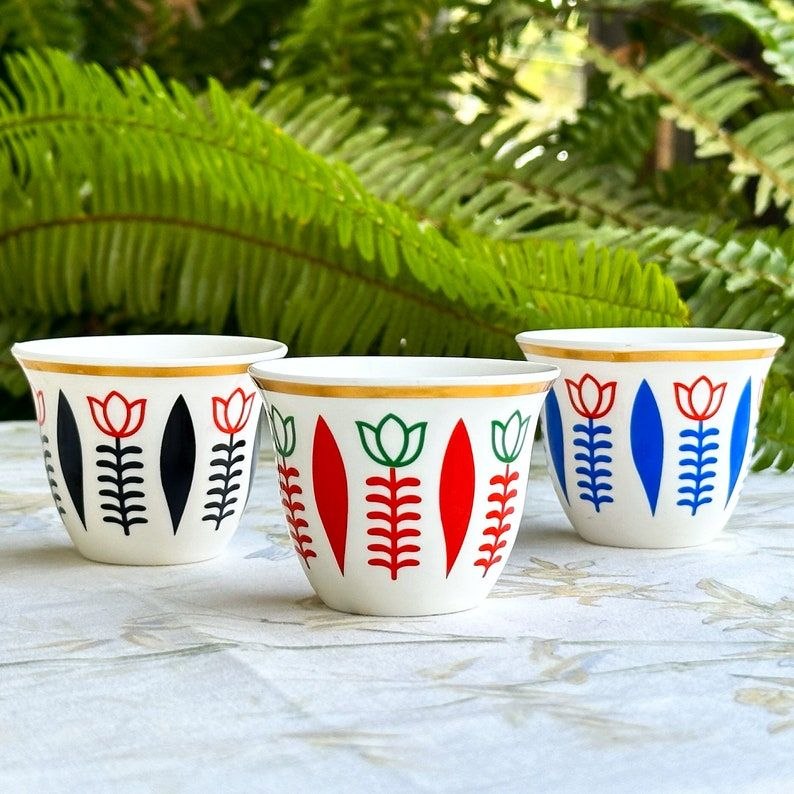
Like the little coffee cup that appears on your morning coffee. Small and handleless, dominantly white, and more often than not decorated with that very specific little flower, red, green, sometimes blue, that somehow feels as Ethiopian as the coffee itself.
So imagine our surprise when we found it in Lebanon. Not a similar cup. Not a vaguely familiar floral pattern. The cup. Same tiny shape. Same handleless body. Same kind of flower sitting there like it had simply crossed the Red Sea and decided to settle down.
Naturally, we had questions. Who made this thing? Where did the flower come from? Was it Ethiopian? Lebanese? Turkish? Chinese? And, most importantly, why does a cup we instinctively think of as Ethiopian show up somewhere completely different?
So we went looking.
In Ethiopia, we call it sini (ሲኒ).
It turns out sini is connected to the Arabic ṣīnī, meaning Chinese or Chinese porcelain. Accounts of Ethiopian coffee culture describe sini as a small “china” cup.
The cup's name is basically telling us:
China.
Suddenly, our supposedly Ethiopian coffee cup has entered a much larger story involving porcelain, trade routes and cultural exchange.
Chinese porcelain was highly prized across the Islamic world and heavily influenced Ottoman ceramics. As coffee became established in the Ottoman Empire, Chinese porcelain influenced what coffee cups looked like.
Workshops in Kütahya produced small coffee cups inspired by imported porcelain, often decorated with flowers and leaves in reds, greens, blues and whites. Their designs travelled beyond Turkey.

The Lebanese version is called a fenjen, or in some contexts shaffe. And, yes, it is remarkably familiar.
The traditional Lebanese cup is small and handleless, with a recognisable floral motif. Its visual language is often linked to Ottoman ceramic traditions, particularly the stylised flowers associated with İznik ceramics. Over time, those motifs were simplified into the graphic flowers seen on everyday coffee cups.
But we haven't found the person who designed our flower. It may have been a commercial pattern, reproduced and adapted until nobody remembers who drew the first one.
Modern Ethiopian sini cups are often manufactured in China. Modern Lebanese fenjen cups can also be made in China, despite being understood as distinctly Lebanese objects.
A cup that feels deeply rooted in Ethiopian coffee culture can be manufactured in China, and a Lebanese one can too.
Because manufacturing origin and cultural origin are not the same thing.
Not exactly.
Is it Ottoman? Not exactly.
Is it Lebanese? Probably not.
Is it Ethiopian? We can't prove that either.
And this is where the story gets more interesting than a neat origin story.
What we're looking at may be a kind of visual migration. Chinese ceramic traditions influence Islamic ceramics. Ottoman workshops reinterpret them. Coffee spreads, and with it comes an entire material culture.
The designs travel through the Mediterranean, the Middle East and the Red Sea, get simplified and reproduced, until a little flower becomes so ordinary that nobody asks where it came from.
The sini itself carries an Arabic connection to Chinese porcelain, while the coffee ceremony reflects Ethiopia's long connections with the wider Red Sea and Arabian world.
That doesn't make Ethiopian coffee any less Ethiopian.
Quite the opposite.
Cultures aren't sealed rooms. Ideas arrive, objects arrive, people arrive. Someone changes something, someone else copies it, and eventually a local version emerges.
Maybe that's what happened to the flower.
We started with a simple question:
Who designed the flower on the sini?
We haven't found the answer. But we may have found a better question:
How did one little flower travel so far that Ethiopia and Lebanon could both look at it and think, “Of course. That's ours”?
Perhaps there was a factory pattern, or dozens of versions, each borrowing from the last.
The evidence points toward a much bigger history: Chinese porcelain, Islamic trade, Ottoman ceramics, Red Sea connections, mass manufacturing and local adaptation.
The flower didn't necessarily belong to one country.
It travelled.
And eventually, Ethiopia made it its own.
Which, when you think about it, is exactly what cultures do: they take something from somewhere else, give it a new meaning, and eventually forget they ever borrowed it.
So the next time someone pours you a buna into a little floral sini, take a second look.
That tiny cup may have travelled farther than your coffee did.
WHAT THE HUB*!?
Support this essay. Readers can contribute up to 50 claps to the studio tally.
A gym has a ceiling. A community doesn't. SweatBox found a second business inside its gym: ETFC, an entertainment property built around fighters, stories and an audience that helped spread it.
Before Illustrator, Canva, Pinterest and AI, there was one kid who could draw, carbon paper, and a neighbourhood ready to copy. Somehow, those humble New Year drawings became a visual language nobody ever formally designed.