The Business of Making People Care
A gym has a ceiling. A community doesn't. SweatBox found a second business inside its gym: ETFC, an entertainment property built around fighters, stories and an audience that helped spread it.
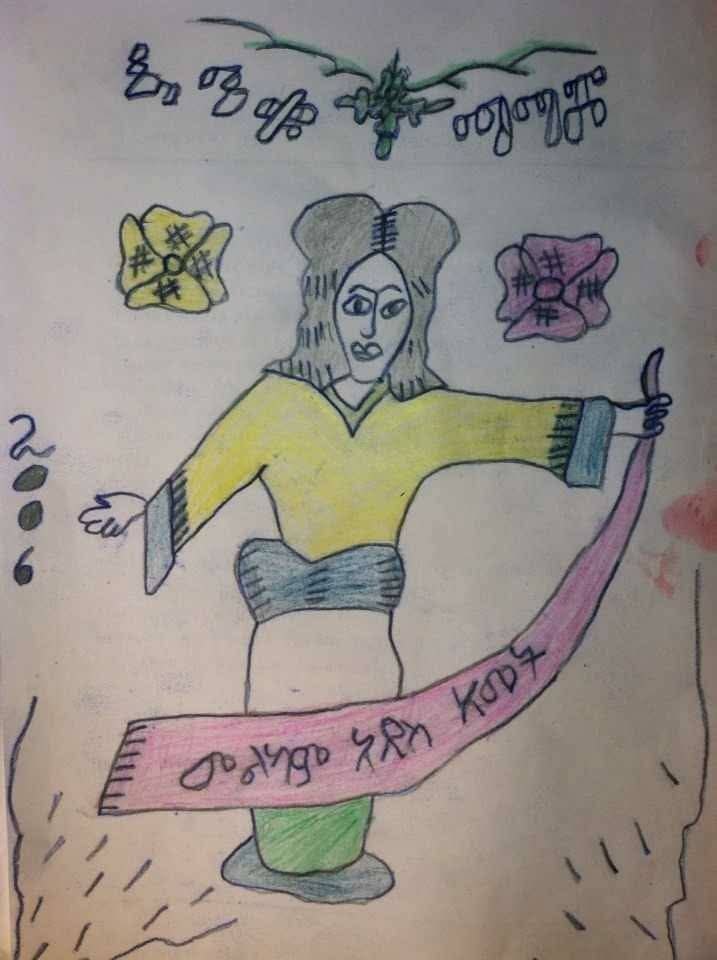
Yellow flowers. Doves. Angels. A few lines of careful handwriting.
There is a particular kind of picture that appears around the Ethiopian New Year, and it has existed for long enough that most of us don't think of it as a style at all.
Children draw it. Children have drawn it for generations. Some are given away. Some are sold. Some are copied from other drawings, sometimes almost exactly.
And yet there is no original version sitting somewhere telling us what one is supposed to look like. So where did the picture come from?


The first clue may be in the flower.
Long before there were paintings, Adey Abeba was already part of the New Year greeting. As the rainy season ends and the yellow flowers appear, children traditionally go from house to house carrying them and singing Abebayehosh. The flower becomes a physical New Year wish: something from the new season, taken from one household to another.
At some point, that greeting found its way onto paper.
Exactly when is harder to establish. Accounts of Enqutatash describe children going from house to house with small paintings, but the trail becomes surprisingly vague when you start looking for a beginning. There is no clear inventor, date, or definitive “first” painting.
What we do find is a tradition that seems to have gradually developed its own visual vocabulary: flowers, doves, angels, religious figures and New Year wishes.
And then things get particularly interesting.
Before Pinterest.
Before stock illustrations.
Before AI.
There was:
one kid who could draw → carbon paper → dozens of copies → neighbourhood distribution.
According to material from Yimtubezina Museum and Cultural Center's 2023 exhibition Music with “Enqutatash” Paintings: “Abebayehosh”, teenagers who were good at drawing would prepare paintings to sell, while carbon paper allowed drawings to be reproduced and then coloured. The paintings circulated through neighbourhoods and markets, including areas around Piassa, Artistic Printing Press and Cinema Ethiopia.
Think about that.
It is, in its own way, a small illustration-production system. One person creates the original; reproduction makes it scalable; other people distribute and sell the result.
And with every copy, the image has another chance to travel.
This also gives us a possible explanation for why these drawings became so recognisable. A visual style doesn't necessarily need an institution, a designer or a formal set of rules behind it. Repetition can do the job.
Copy something enough times and it starts to feel like it has always looked that way.
There is a name for what we are looking at: vernacular design.
Design that develops outside formal design institutions, shaped by the people who make and use it.
The Enqutatash painting is a particularly good example. There were recurring motifs, familiar compositions, copying, variation and even a small commercial market, but no brand guide telling anyone what belonged on the page.
Children learned by looking. Artists influenced other artists. Popular drawings were reproduced. The things that worked stayed. The things that didn't gradually disappeared. The result was a visual language that could be recognised without ever being formally defined.
That raises another question: how much of what we think of as “Ethiopian visual identity” developed in exactly this way?
Not through a famous artist or a national institution, but through thousands of ordinary people making, copying and circulating images.
The tradition is still with us, even if the way these paintings are made, shared and encountered has changed. The paintings belong to a world in which a New Year greeting could be a physical object that passed directly from one person to another. A child made something, carried it around the neighbourhood, and someone decided to keep it.
Some of those drawings survived. Others were simply part of the season and then disappeared with it. And perhaps that's why they are difficult to trace. Ephemeral things rarely leave good archives. A small painting made by a child and sold for a few birr was never expected to become a historical document.
Which leaves us piecing the story together from memories, surviving examples, artists' recollections and the work of people now trying to preserve the tradition.
So we still don't know exactly where the first enqutatash painting came from.
Maybe it began with someone copying a flower.
Maybe it began with an artist adapting an existing image.
Maybe there was never a first.
What we can see, though, is what happened afterwards: a seasonal flower became a drawing; drawings became commodities; copies created a shared visual vocabulary; and generations of children kept adding their own versions to it.
For something that was never formally designed, it developed quite a look.
And maybe that's the most interesting thing about it.
Support this essay. Readers can contribute up to 50 claps to the studio tally.
A gym has a ceiling. A community doesn't. SweatBox found a second business inside its gym: ETFC, an entertainment property built around fighters, stories and an audience that helped spread it.
We thought the little flower on our coffee cup was Ethiopian. Then we found the same one in Lebanon. Turns out, it may have travelled through centuries of porcelain, trade and cultural exchange before becoming something we simply called sini.